
Clarifying the Value of High-Purity Quartz

Why PAL Quartz’s Crête White Deposit Matters
As global industries accelerate toward electrification, clean energy, and advanced technologies, the demand for High-Purity Quartz (HPQ) and silica-based materials continues to rise. From semiconductors and solar panels to batteries and specialty industrial applications, silica has become one of the most strategically important mineral resources in the modern economy.
PAL Quartz’s Crête White Property, located in Baie-Johan-Beetz on Québec’s North Shore, is positioned within this rapidly growing market as a high-potential source of high-purity quartz material.
Understanding the Different Grades of Silica
Not all silica products are created equal. The market ranges from lower-purity industrial uses to ultra-high-purity applications required by advanced technologies. As purity increases, so does the material’s value and strategic importance.
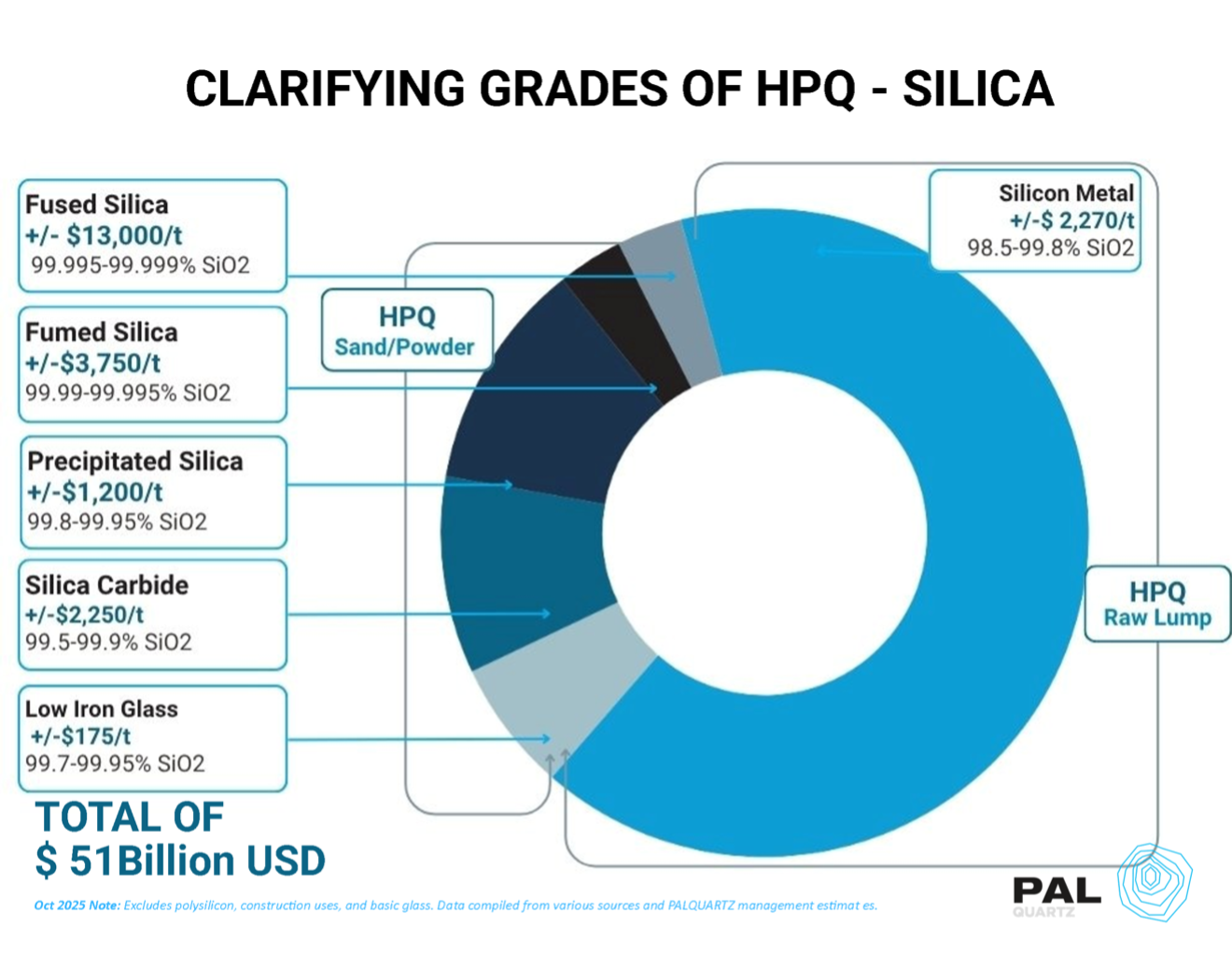
The chart above highlights the broad spectrum of silica-derived products and their approximate market values:
Low Iron Glass (99.7–99.95% SiO₂)
Used in architectural and solar glass applications.Silica Carbide (99.5–99.9% SiO₂)
Essential for abrasives, electronics, and EV technologies.Precipitated Silica (99.8–99.95% SiO₂)
Commonly used in tires, rubber, food, and specialty chemicals.Fumed Silica (99.99–99.995% SiO₂)
A high-value material used in pharmaceuticals, coatings, and advanced manufacturing.Fused Silica (99.995–99.999% SiO₂)
One of the purest forms of silica, required for semiconductors, optics, and precision electronics.
At the foundation of many of these downstream products lies high-purity quartz feedstock — the raw material required to produce silicon metal and refined silica derivatives.
The Strategic Importance of HPQ Deposits
The global silica and quartz market is increasingly driven by technology-focused industries. Silicon metal, produced from high-purity quartz, is critical for:
Solar photovoltaic cells
Semiconductors and microchips
Battery technologies
Electronics and telecommunications
Advanced industrial manufacturing
This growing ecosystem represents a multi-billion-dollar market opportunity. According to PAL Quartz estimates and industry data referenced in the graphic, the combined value of advanced silica applications exceeds USD $51 billion, excluding polysilicon, construction uses, and standard glass markets.
As governments and industries seek secure North American supply chains for critical minerals and advanced materials, high-quality quartz deposits are gaining strategic significance.
Why the Crête White Property Stands Out
PAL Quartz’s Crête White Property benefits from several key advantages:
Accessible Infrastructure
The deposit is located approximately 13 km east of Baie-Johan-Beetz, Québec, along Route 138, providing year-round accessibility and proximity to regional infrastructure.
Surface Exposure
The main quartz veins reportedly have little to no overburden coverage, potentially simplifying exploration and future extraction activities.
High-Potential Geological Characteristics
The property’s prominent white quartz formation — from which the “Crête White” name originates — reflects the visual and geological characteristics often associated with high-purity quartz systems.
Québec Advantage
Québec continues to strengthen its position as a preferred jurisdiction for critical mineral development thanks to:
Renewable hydroelectric power
Established mining expertise
Political stability
Strategic access to North American and international markets
Positioned for the Future
As industries continue transitioning toward electrification, renewable energy, and digital infrastructure, demand for premium silica materials is expected to grow substantially.
High-purity quartz is no longer simply an industrial mineral — it is becoming a strategic material underpinning the technologies of the future.
With its location, geological characteristics, and exposure to high-value silica markets, PAL Quartz’s Crête White Property represents a compelling opportunity within the evolving advanced materials sector.